

Palmistry Guide: How to Read Palms Remedies (Upay)
Palmistry — also called chiromancy — is the ancient practice of reading the shape, lines, and mounts of the hand to understand a person’s character, health tendencies, and life patterns.
Believed to have originated in ancient India and later spread to China, Persia, Egypt, and Greece, this practice has fascinated people for thousands of years, including philosophers like Aristotle, who wrote about hand lines over 2,500 years ago.
This guide brings together everything you need to know about palmistry — hand types, mounts, major and minor lines, finger meanings — into one simple, easy-to-follow article, along with a pointwise remedies (upay) section.
A quick honest note before we begin: there is no scientific evidence linking palm features to personality or future events. Palmistry is best approached as a traditional, reflective, and entertaining practice — a tool for self-awareness rather than a guaranteed predictor of your future.
To Contact the experts: Palmistry Guide
- Call/ WhatsApp: +91 9538602626
- Email: enquiry@aadishakti.co
1. Which Hand Should You Read?
There are a few different schools of thought here, and it’s worth knowing all of them rather than treating one as the “correct” answer:
- The gender-based rule: In one common tradition, for men the left hand shows what you were “born with” (your natural, inherited traits) while the right hand shows what you’ve “acquired” through life experience. For women, this is reversed.
- The dominant-hand rule: Many modern palmists instead go by which hand is dominant. Your dominant hand shows how your natural traits have actually been put into practice, while your non-dominant hand reflects your inborn character and hidden potential.
- The Eastern vs. Western approach: Traditional Indian palmistry often gave more weight to the left hand for women and the right hand for men. However, many modern practitioners now suggest giving the right hand more importance for both genders, since it reflects a person’s ongoing choices, growth, and life circumstances more accurately in today’s world.
The safest approach: Read both hands and compare them. If the two hands are quite different, it usually means the person has been actively working to change or develop themselves. If the right hand shows clearer, better-defined lines than the left, it’s traditionally taken to mean the person has grown into a fuller expression of their natural potential since birth.
Get Accurate Predictions | Use our Professional Astrology Services
2. Understanding Hand Shapes: Palmistry Reading
There are actually two separate classification systems used in palmistry, and mixing them up is one of the most common sources of confusion — so let’s keep them clearly separate.
System 1: The Four Elemental Hand Types (Most Commonly Used Today)
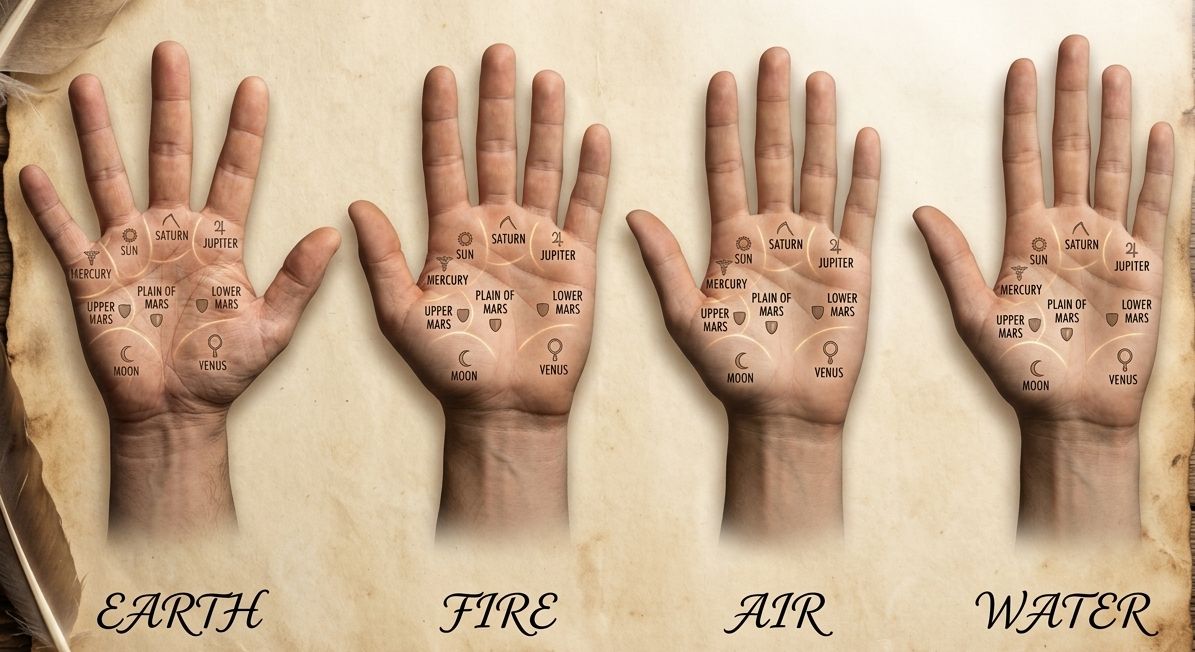
This system matches each hand shape to one of the four classical elements — Earth, Air, Fire, and Water — the same elements used in astrology.
- Earth Hands — Square, broad palms with short fingers, thick or coarse skin, often warm/ruddy in color. Palm length roughly equals finger length.
-
- Traits: Practical, grounded, reliable, hardworking, sometimes stubborn or overly materialistic.
- Air Hands — Square or rectangular palms with long fingers, sometimes bony or with visible knuckles, dry skin. Palm length is shorter than finger length.
-
- Traits: Sociable, witty, intellectually curious, good communicators; can become anxious if not mentally stimulated, sometimes come across as detached.
- Fire Hands — Square or rectangular palms with comparatively shorter fingers, often flushed or warm-toned skin. Palm length is greater than finger length.
-
- Traits: Passionate, confident, spontaneous, natural leaders; can be impulsive or lack tact under pressure.
- Water Hands — Long, oval-shaped palms with long, flexible, tapering fingers, often soft or slightly clammy skin. Palm length roughly equals finger length, though the palm may be narrower.
-
- Traits: Creative, intuitive, emotionally sensitive, compassionate; prone to mood swings and can be easily hurt.
System 2: Cheiro’s Seven Hand Types (Traditional Classification)
Named after the famous palmist “Cheiro,” this older system divides hands into seven types based on shape and finger characteristics:
- Elementary Hand — Coarse, heavy, thick palm with short fingers and few lines; associated with basic instincts over reasoning.
- Square Hand — Practical, orderly, disciplined; corresponds closely to the “Earth Hand” in the elemental system.
- Spatulate Hand — Restless, energetic, inventive, and ahead-of-their-time; corresponds closely to the “Fire Hand.”
- Philosophic Hand — Long, angular, with developed knuckles; analytical, thoughtful, often drawn to mysticism or philosophy.
- Conic Hand — Slightly tapering palm; artistic appreciators (more consumers than creators of art), generous but sometimes indulgent; roughly aligns with the “Air Hand.”
- Psychic Hand — Long, narrow, fragile-looking with slender tapering fingers; idealistic, gentle, intuitive; corresponds to the “Water Hand.” This is considered the rarest hand type.
- Mixed Hand — A blend of multiple types; versatile but sometimes inconsistent in purpose. This is actually the most common hand type among people today.
3. The Mounts of the Hand: What They Reveal
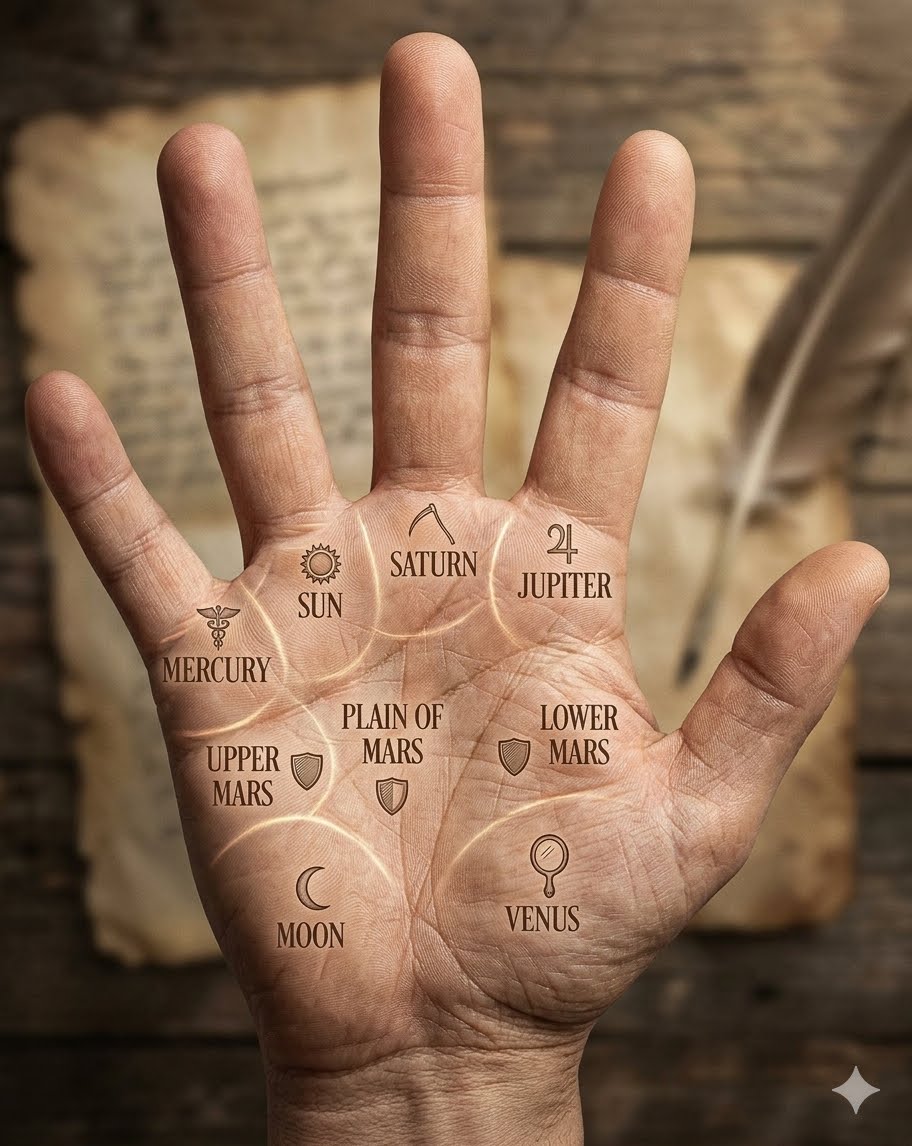
The fleshy, slightly raised pads at the base of each finger and around the palm are called mounts, and they’re named after the seven classical planets used in astrology. A well-developed, evenly centered mount reflects a healthy expression of that planet’s qualities; an overdeveloped or underdeveloped mount can reflect an excess or a deficiency.
- Mount of Jupiter (below the index finger) — Confidence, leadership, ambition, and sense of authority. Overdeveloped: arrogance and bossiness. Underdeveloped: low self-esteem, lack of ambition.
- Mount of Saturn (below the middle finger) — Wisdom, responsibility, and seriousness. Best when only slightly padded — overdeveloped versions are linked to pessimism and a gloomy, isolated nature.
- Mount of Apollo/Sun (below the ring finger) — Creativity, optimism, artistic talent, and vitality. Overdeveloped: vanity and extravagance. Underdeveloped: lack of interest in art or beauty.
- Mount of Mercury (below the little finger) — Communication, business acumen, wit, and adaptability. Well-developed in successful communicators, lawyers, and businesspeople.
- Mount of Luna/Moon (lower outer edge of the palm, opposite the thumb) — Imagination, intuition, and emotional depth. Strongly linked to creative and artistic careers.
- Mount of Venus (base of the thumb) — Love, warmth, vitality, and sensuality. The largest mount on the palm; strongly developed versions indicate good health and a warm nature, while an underdeveloped mount suggests low energy and emotional coldness.
- Mount of Mars (there are actually two: Lower Mars near the thumb side, and Upper Mars near the Mercury/Moon side) — Courage, resilience, and self-control. Lower Mars reflects active/aggressive courage; Upper Mars reflects passive/patient courage and the ability to withstand hardship.
- Mount of Neptune (a smaller, secondary mount between Luna and Venus) — Linked to intuition, charisma, and the connection between the conscious and subconscious mind.
Transform Your Space: Expert Vastu Consultation Services
4. The Five Major Lines in Your Palm
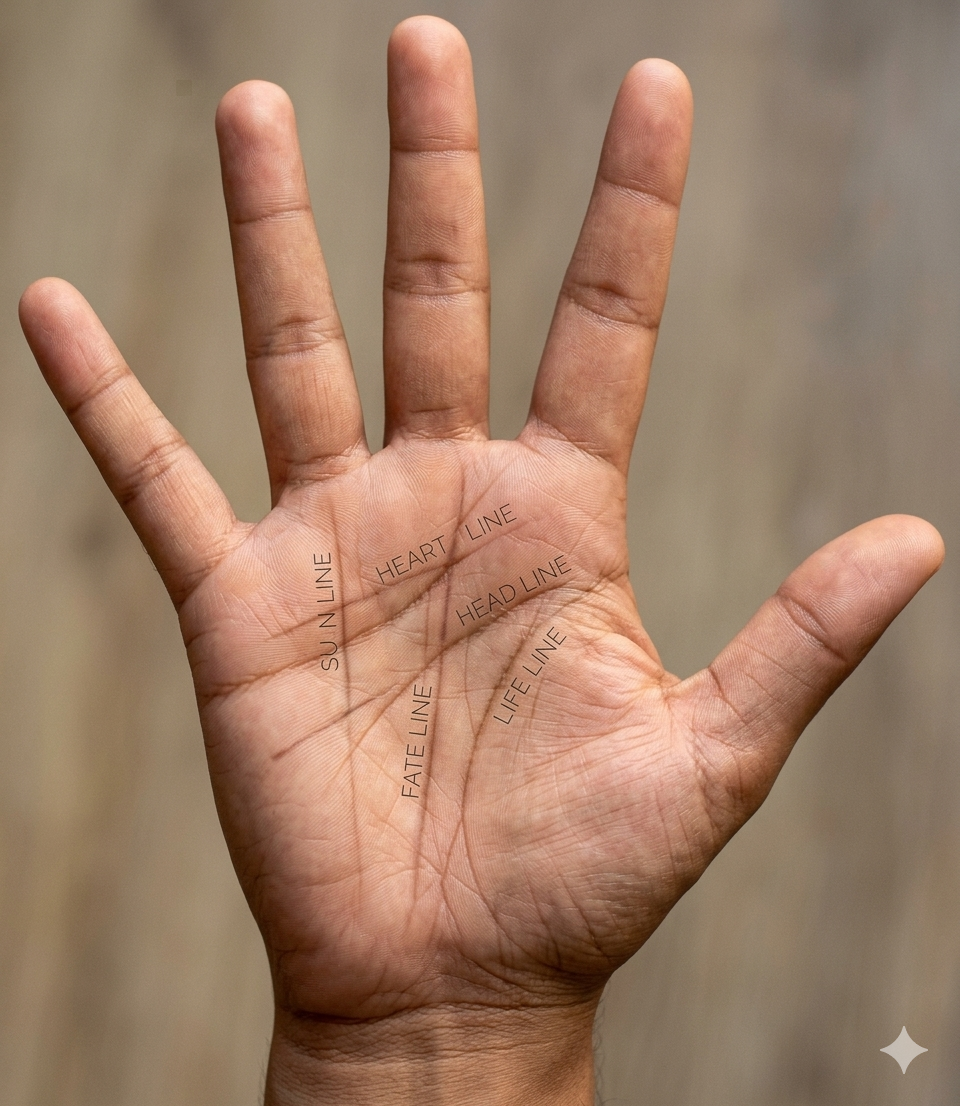
These are the primary lines palmists study, though not everyone has all five clearly visible.
The Life Line
- Curves around the base of the thumb, encircling the Mount of Venus.
- Reflects your general vitality, health, and major life changes — not the length of your life (this is one of the most common myths in palmistry, and virtually every modern source agrees the line’s length has no bearing on lifespan).
- Long and deep = strong vitality and energy.
- Short or shallow = doesn’t mean a short life — often linked instead to being easily influenced by others.
- Breaks in the line = sudden lifestyle changes.
- A circle on the line = a period of illness or hospitalization.
The Head Line
- Usually starts near the Life Line and travels across the palm.
- Reflects thinking style, intellect, decision-making, and concentration.
- Straight line = practical, realistic thinking.
- Curved/sloping line = creative, imaginative thinking.
- Wavy line = shorter attention span.
- Deep, long, unbroken line = clear, focused thinking.
- A line that droops steeply toward the Mount of the Moon = strong imagination, sometimes linked to escapism if unchecked by other positive signs elsewhere in the hand.
The Heart Line
- The topmost horizontal line, running below the fingers.
- Reflects emotional nature, romantic tendencies, and (in traditional readings) cardiac health.
- Starts below the index finger = generally content in love.
- Starts below the middle finger = more self-focused in relationships.
- Long and curvy = expresses emotions freely.
- Straight and parallel to the Head Line = good emotional control.
- Broken or crossed by small lines = past emotional difficulty or heartbreak.
The Fate Line
- Also called the Line of Destiny; runs vertically from the base of the palm upward, usually toward the Mount of Saturn.
- Reflects career direction and how much external circumstances (versus personal choice) shape your path.
- Deep and unbroken = strong sense of direction and likely career success.
- Starting joined to the Life Line = a self-made person who develops goals early.
- Starting from the Mount of the Moon = success dependent on the help or influence of others.
- Not everyone has a visible Fate Line — its absence simply suggests a more flexible, less externally-determined life path, not an “uneventful” one as some older sources dramatically claim.
The Sun Line (Line of Apollo)
- A vertical line running toward the Mount of Apollo/Sun, often shorter and only appearing above the Heart Line.
- Reflects the potential for recognition, creative talent, and the ease with which success is achieved — rather than always meaning fame specifically, despite common belief.
- A well-marked Sun Line tends to make success and satisfaction easier to achieve, regardless of which field a person is in, since it reflects innate ability more than a guaranteed public spotlight.
5. Minor Lines Worth Knowing
These appear less often but add detail to a reading:
- Line of Mercury (Health Line) — Runs from the base of the palm up toward the Mount of Mercury; traditionally linked to digestion and liver health. A clear, straight line suggests good health; a twisted or broken one suggests digestive sensitivity. Its complete absence is actually considered the best sign of a robust constitution.
- Girdle of Venus — A semi-circular line above the Heart Line, between the Jupiter/Saturn and Sun/Mercury fingers. Linked to heightened sensitivity and emotional intensity. Older texts often over-dramatized this line’s meaning around “excess” — in a balanced hand, it simply points to a more emotionally intense and artistic personality.
- Line of Intuition — A curved line on the Mount of the Moon, more common in Water-type hands. Indicates strong intuitive or “gut feeling” abilities.
- Line of Marriage/Affection — Small horizontal lines on the side of the palm below the little finger. Reflects significant emotional attachments — not necessarily formal marriage. Multiple lines can mean multiple significant relationships, not necessarily multiple marriages.
- Line of Mars — Runs parallel and inside the Life Line; considered a “reinforcement” line that adds extra vitality and resilience, especially useful in physically demanding careers.
- Ring of Solomon — A small curved line at the base of the index finger; associated with interest in spiritual or philosophical study.
- Ring of Saturn — A line crossing the Mount of Saturn; traditionally viewed as an unfavorable marking linked to lack of follow-through or sustained success.
- Rascettes (Bracelets) — Horizontal lines at the base of the palm, near the wrist. Clear, well-formed rascettes are linked to good health and vitality.
- Travel Lines — Small vertical lines rising from the wrist area toward the Mount of the Moon; linked to journeys, both physical and career-related.
- Children Lines — Fine vertical lines on the Mount of Mercury, traditionally used to estimate the number of children a person may have. It’s worth being clear that this is considered one of the least reliable areas of palmistry even among practitioners themselves, given how inconsistent interpretations are across traditions.
Order a Computer Horoscope (Birth Chart / Kundli/ Jathaka Online / जन्म कुंडली ) to get insights into your future
6. What Your Fingers Reveal
- Length of fingers overall: Long fingers suggest attention to detail and patience; short fingers suggest quick decision-making and impatience with minor details.
- Jupiter finger (index): Long and well-set = natural leadership and confidence. Very long = risk of arrogance. Short = shyness or lack of self-assertion.
- Saturn finger (middle): Normally the longest finger. Balanced length = responsibility and steadiness. Unusually long or short = tendency toward gloominess or recklessness.
- Sun finger (ring): Long = artistic talent, but also a tendency toward vanity or gambling if excessive. Short = less interest in aesthetics.
- Mercury finger (little): Long = strong communication and business skills. Short = quick temper, and if combined with a low-set finger, more struggle to establish a career.
- Spacing between fingers: Wide gaps generally suggest independence of thought and action; fingers held tightly together suggest a more reserved, cautious, tradition-bound personality.
- Finger joints: Smooth joints suggest impulsive, instinctive thinking; “knotty” or more pronounced joints suggest analytical, methodical thinking.
7. Palmistry Remedies & Upay (Pointwise)
Just like Vedic astrology links planets to specific gemstones and rituals, traditional Indian palmistry (rooted in Samudrik Shastra) connects each mount to its corresponding planet — meaning many of the same remedies used to strengthen weak planets in astrology are also recommended here to balance an underdeveloped or overly excessive mount.
These remedies are rooted in tradition and personal belief rather than scientific evidence, so treat them as supportive, optional practices.
If the Mount of Jupiter is weak (low confidence, lack of ambition):
- Wear a Yellow Sapphire (Pukhraj) after consulting a qualified astrologer for suitability.
- Donate yellow items — turmeric, yellow cloth, or chana dal — on Thursdays.
- Practice small acts of leadership daily (taking initiative in minor decisions) to build the confidence this mount represents.
If the Mount of Saturn is overdeveloped (pessimism, isolation):
- Wear a Blue Sapphire only after professional consultation, as this stone can have strong and sometimes unpredictable effects.
- Donate black sesame seeds or iron items on Saturdays.
- Spend time outdoors and around uplifting company to counter the tendency toward isolation this mount can bring.
If the Mount of Sun/Apollo is weak (low creativity, low recognition):
- Wear a Ruby, associated with the Sun, in consultation with an astrologer.
- Offer water to the rising Sun each morning (Surya Arghya) while facing east.
- Engage regularly in a creative hobby — art, music, or writing — to actively develop this mount’s qualities over time.
If the Mount of Mercury is weak (communication struggles):
- Wear an Emerald, traditionally associated with Mercury, after consultation.
- Practice public speaking or writing regularly to strengthen communication skills.
- Donate green vegetables or green clothing on Wednesdays.
If the Mount of the Moon is weak (low intuition, emotional imbalance):
- Wear a Pearl (Moti) in silver, a traditional remedy for strengthening lunar energy.
- Keep a consistent sleep routine, since lunar energy in Vedic thought is closely tied to the mind and rest.
- Practice meditation, particularly around the new and full moon, to support emotional balance.
If the Mount of Venus is weak (low vitality, emotional coldness):
- Wear a Diamond or White Sapphire, associated with Venus, after consultation.
- Spend time in nature, around music, or engaging in artistic appreciation to activate this mount’s qualities.
- Practice acts of generosity and warmth toward others.
If the Mounts of Mars are weak (low courage, poor resilience):
- Wear Red Coral (Moonga), traditionally associated with Mars, after consultation.
- Take up a physical discipline — martial arts, strength training, or a regular sport — to build the courage and resilience this mount represents.
- Donate red lentils (masoor dal) or red cloth on Tuesdays.
General Hand & Palm Care Practices
- Keep your palms clean and moisturized — in traditional belief, healthy skin allows the mounts and lines to be read more clearly and reflects better overall vitality.
- Practice regular hand and finger stretches, since palmists traditionally believe physical vitality in the hand mirrors vitality in the body.
- Avoid unnecessarily cutting or injuring the palm, since in tradition, scars on major lines are believed to disrupt the flow of the qualities that line represents.
- Revisit your palm readings periodically — since minor lines can genuinely change over months and years (unlike the major lines, which stay relatively fixed), treat this as a way to track your own personal growth rather than a fixed, unchangeable verdict.
Get insights about your love, career, and life path with: our personalized Tarot readings services
8. Frequently Asked Questions
Q: Does the length of my life line tell me how long I’ll live?
-
- No — this is one of the most persistent myths in palmistry. Nearly every modern source agrees the life line reflects vitality, health tendencies, and major life changes, not lifespan.
Q: Which hand is the “real” one to read?
-
- There’s genuine disagreement among traditions here. The safest approach is to read both hands: your dominant hand shows how your traits have been expressed in practice, and your non-dominant hand shows your innate, natural character.
Q: Can my palm lines change over time?
-
- Yes, especially the minor lines — they can appear, fade, or shift as your life circumstances change. The five major lines (Life, Head, Heart, Fate, Sun) are more stable but can still show subtle changes over the years.
Q: Is palmistry scientifically proven?
-
- No. There is no reliable scientific evidence linking hand features to personality traits or future outcomes. It’s best treated as a traditional, symbolic, and reflective practice — useful for self-awareness and conversation, not as a substitute for professional advice in health, career, or relationship matters.
Q: Do I need to memorize every mount and line to get value from palmistry?
-
- Not at all. Start with the four major hand types and the five major lines — that alone gives a reasonably complete picture. The mounts, minor lines, and finger details are best added gradually as you get more comfortable.
Q: What’s the difference between Cheirognomy and Cheiromancy?
-
- Cheirognomy is the study of hand shape and mounts; Cheiromancy is specifically the study of lines. A complete palm reading uses both together rather than relying on lines alone — this is one of the most common mistakes beginners make.
Purchase a detailed Horoscope Matching Report (Kundli Milan) to check marriage compatibility and 36 Guna scores based on Vedic astrology.
Final Thoughts
Palmistry offers a rich, symbolic language for reflecting on your personality, tendencies, and life patterns — hand shape, mounts, and the five major lines together give a surprisingly complete picture once you understand how they interact. That said, it’s worth holding this practice with the right amount of perspective: there’s no scientific backing for the idea that your palm predicts your future, and no line or mount should ever replace real medical, financial, or relationship advice. Used thoughtfully, palmistry can be a fun and meaningful way to start conversations about who you are and where you’re headed — just remember that, as with astrology, the real work of shaping your life still lies in your own hands, not just the lines on them.
Terms used here: palmistry, palmistry reading, life line palmistry, marriage line palmistry, heart line palmistry, fate line palmistry, head line palmistry, sun line palmistry, palm reading lines, is palmistry accurate, palmistry for female, palmistry for male
